
Deep Eshelby Network: An AI framework for multiscale continuum micromechanics homogenization schemes with complex inclusion shapes
Author(s)
Tag
Deep Eshelby Network: An AI framework for multiscale continuum micromechanics homogenization schemes with complex inclusion shapes
Abstract
Continuum micromechanics homogenization provides an efficient framework to relate the microstructural features of heterogeneous materials to their macroscopic mechanical response. The microstructure is idealized as an assembly of interacting matrix–inclusion problems, each governed by Eshelby’s analytical solution for ellipsoidal inclusion shapes. This assumption severely simplifies the often complex morphology of real materials—and, owing to the uniformity of strains inside Eshelby’s inclusion, provides access to average strains rather than the underlying field fluctuations in the heterogeneities of the material.
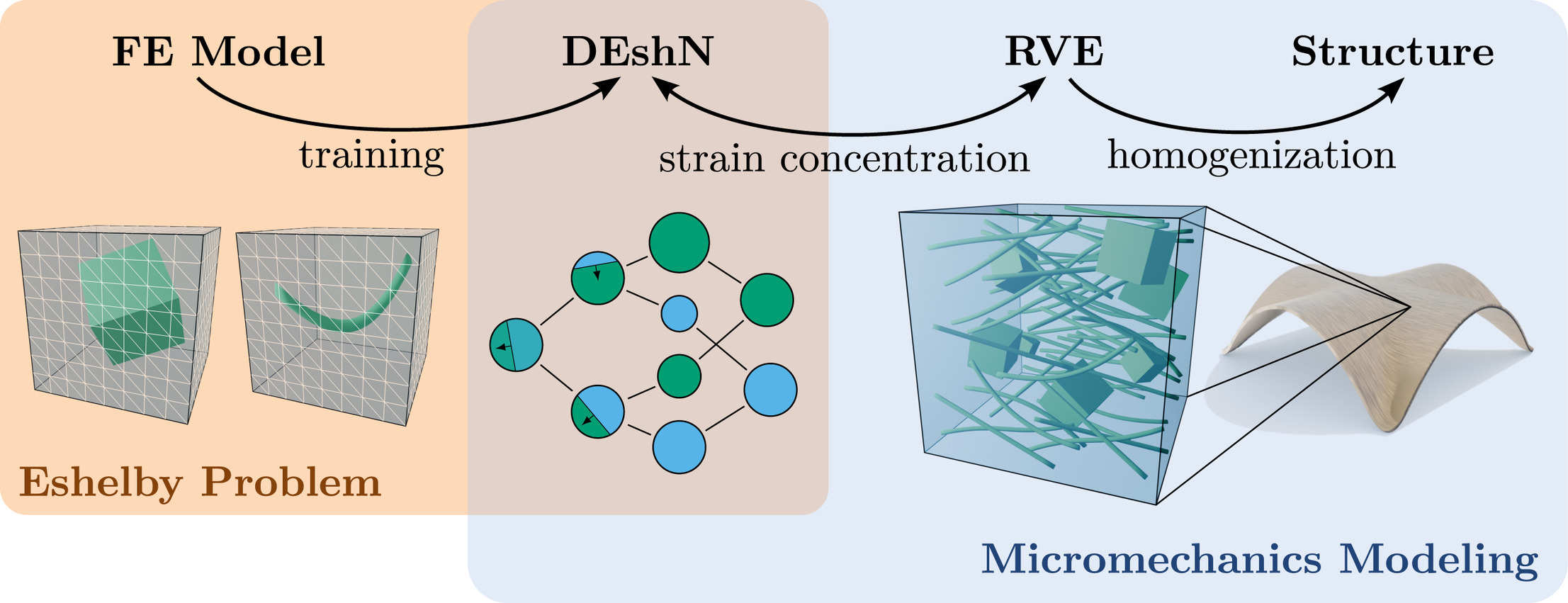
To address these limitations, we propose the Deep Eshelby Network (DEshN), a machine-learning framework that generalizes the Eshelby problem to non-ellipsoidal inclusion geometries. The network consists of a Deep Material Network (DMN) that incorporates physical constraints through laminate building blocks into a tree-like architecture and a single linear layer that modulates the weights and orientations of the DMN. Trained on finite element solutions of inclusion problems with diverse shapes and stiffness ratios, the DEshN provides rapid and accurate predictions that can be seamlessly integrated into classical homogenization schemes. In this way, DEshN-based homogenization retains the efficiency of continuum micromechanical approaches while extending their applicability to materials with heterogeneities of arbitrary shape, volume fraction, orientation distribution, and even hierarchical multiscale organization.
To unveil its potential, a DEshN is trained on superspherical inclusions to predict the homogenized stiffness for orthotropic matrix-inclusion-type materials and polycrystalline materials with aligned or randomly oriented superspheres, as a function of the supersphere shape parameter. This task could not have been solved with the approaches developed so far.
Download
